BY:- Adv. Palak Gupta

BSc. L.L.B. L.L.M. ( Pursuing from University of Mumbai)
IN THE HON’BLE SUPREME COURT OF INDIA,
HIGH COURT OF DELHI, MUMBAI, PUNJAB AND HARYANA.
Abstract
Author in this article after critical comparitive and in depth analysis of Indian Criminal System would like to highlight and elaborate the loopholes in its doctrine of presumption of innocence of an alleged accused until and unless he is proven guilty which holds good in theoretical terminology of criminal jurisprudence and books but, practically fails when confronted in Indian society of high varsity. This has made the above notion more ideal and less real. A society where judgement is passed before hearing, in such a society justice is not able to reach each and every corner just due to the fact that “what will others say?” prevails more than the fact that an alleged accuse is “ innocent until and unless proven guilty” that too beyond reasonable doubt. Such prevailing myths have given a boost to wrongful convictions which is not at all relative with modern theories of jurisprudence. Author feels, criminology has to elaborate its scope by considering the failure of this doctrine to be one of the major reasons in causation of crimes. Ei incumbit probatio qui dicit, non qui negat is the legal maxim which gives a synonym to this principle by stating that the burden of proof is on one who declares and not the one who denies. This has been affirmed by Justice K.T.Thomas in State of West Bengal v. Mir Mohammad Omar and Others,..This means that the one who makes allegations should be with onus probandi to prove them. Until he proves them beyond reasonable doubt, no one can be called a criminal. But, is this holding practically good in our today’s society?
Introduction
Right to fair trial as enshirned under Article 21 of the Indian Constitution is considered to be as an integral part of right to life as well as the cornerstone in democracy. In Ratiram v. State of Madhya Pradesh through Inspector of Police AIR 2012 SC 1485 it has been remarked by the apex court that “ A fair trial is the heart of criminal jurisprudence and in a way an important facet of democratic polity governed by Rule of law”. Rule of law where the principles of natural justice have enriched law and constitutions all over the world strictly emphasize on the rule of equity, justice and good conscience. For fair trial and fair play, Audi Alteram Partem i.e. the rule of fair hearing comes into play. As has been observed by Hon’ble Supreme Court in Sanjeeva Rao v. State of Andhra Pradesh (2012) 7 SCC 56 (63), Grant of fairest opportunity to the accused to prove himself innocent is the object of every fair trial. This principle has been universally accepted by international covenants as well. Article 7 of Universal Declaration of Human Rights coinciding with Article 14 of the Indian Constitution clearly mentions of Equality before the law and equal protection of law forming a strong background and scope for Article 10 of UDHR i.e. “Everyone is entitled in full equality to a fair and public hearing by an independent and impartial tribunal, in the determination of his rights and obligations and of any criminal charge against him”. International Covenant on civil and political rights has also preserved Right to fair trial of utmost importance under its governing Article 14 and 16. Hence, as has been indicated in State of Punjab v. Baldev Singh, AIR 1999 SC 2378 A conviction resulting from an unfair trial is contrary to law and our concept of justice emphasized in the Preamble.

Dimnishing values of fair trials
It is somewhere regretful to mention over here that we are part of a nation where A person is presumed guilty even after declared and adjudged by the court to be innocent. Stack v. Boyle, 342 U.S. 1, 8 (1951) The presumption of innocence came intoeffect when a defendant was arrested and charged. One of the most significant protections that accompanied the presumption of innocence was the constitutional right to pretrial release through bail. The very common very first trial, where there is no hearing, no judgement but, still turns out to be the strongest instrument in influencing and formulating public opinion all over our nation as well as in world is the trial by media. Recently, in Padmavat issue, the movie was in public opinion became a culprit of infringing religious and moral values of Rajput community and was judged even before its release , even before censor board or public could see it and make its opinion on it. In recent times there have been numerous instances in which media has conducted the trial of an accused and has passed the verdict even before the court passes its judgment. Some famous criminal cases that would have gone unpunished but for the intervention of media, are Priyadarshini Mattoo case, Jessica Lal case, Nitish Katara murder case and Bijal Joshi rape case. The media however drew flak in the reporting of murder of Aarushi Talwar, when it preempted the court and reported that her own father Dr. Rajesh Talwar, and possibly her mother Nupur Talwar were involved in her murder, the CBI later declared that Rajesh was not the killer. On April 19th 2017 , the U.S. Supreme Court issued a 7-1 decision in Nelson v. Colorado, struck down the Colorado law that forced people to go to court to affirmatively prove their own innocence in order to recover funds paid as a result of a criminal conviction, after the conviction was reversed on appeal. The Court found this scheme unconstitutional because requiring people to prove their own innocence disregards the presumption of innocence. Before this, which means until 2017, people were going against the wind . It is sorrowful that a nation like U.S. from which Indian Constitution has borrowed its fundamental principle also adjudged a matter involving a principle which was deduced years ago.
Is there a need of revisiting the principle of presumption of innocence?
There is a huge list of offences in Indian Penal Code under S 121, 124 A, 131, 300, 375 etc. which are considered to be non-bailable offences as per our Code of Criminal Procedure where an accused is detained in jail even though his guilt has not been proved due to the gravity of offence which cannot be neglected. In such a case would you call for the need of revisiting the principle or Is there a need to change the mind set of society so that they are obliged with their duty to restore the status of a person who has been released by the court as innocent? The later answer suits better because again and again one cannot rely only on judicial pronouncements, Supreme Court’s intervention for a better interpretation in various cases and legislature to amend its notions and concepts so that infringement of one’s right is prevented. Under Section 113A, 113B and 114A of Indian Evidence Act, there is an already presumed guilt of family and husband if a women dies under suspicious circumstances within 7 years of her marriage, or there is dowry death as has been highlighted in S. 498 A and 304 B of the Indian Penal Code. In such circumstances, if we say change the law, than it will be misused by the male dominated society and if we say let it be as it is, it is already being misused by the females who file false cases to blackmail their in laws family for money and property. There are some statutory exceptions to the above mentioned maxim as has been illustrated above due to which Revisiting the law is not advisable. Author feels that a better awareness and intellect among society has to be created so that an alleged accused is not treated as a real accused before final decree of court.
How the principle of presumption of innocence can be implemented in better manner
In Woolmington vs. DPP, 1935 AC 462 at 481 The ‘right to silence’ has been considered to be a principle of common law and it means that normally courts or tribunals of fact should not be invited or encouraged to conclude, by parties or prosecutors, that a suspect or an accused is guilty merely because he has refused to respond to questions put to him by the police or by the Court. Similarly, in our real societies as well, one should not make their judgements on mere silence of accused. A person’s silence if doesn’t prove his innocence, it has to be understood that even what comes out louder is not always the truth. The recent Kulbhushan Jadhav Case where without any extradition treaty, Kulbhushan Jadhav has been presumed to be a RAW agent, where under what circumstance he has given his affirmative statement for same, is unknown to all and just because he is an Indian national in Pakistan, he is facing the ill treatment and punishment without even an opportunity of fair investigation to India is one such example which author would like to illustrate so that our Indian society can realize the gravity of result of their accusations on a person. The 2016 JNU sedition case was marked as the biggest error in law where the accused was asked to prove his innocence just because of societal pressure. One of the basic reasons why women condemned in the society after they go through rape trauma is the pre decided judging mentality of people which has to be revisited if we want justice to be construed and precieved in true manner in our nation.
Conclusion
We all proclaim that all are innocent until proven guilty at trial but we allow ourselves to predict who are guilty long before trial and who are not. We need to change this mentality of being confirmation bias and of the view that we know everything. Author would like to highlight that My name is Khan and I am not a Terrorist left a great message to all of us which is don’t judge just on the basis of circumstances, appearance. Remmeber that even great criminologists failed and were criticized when they predicted their theories of recognizing a criminal on basis of his circumstances, appearance and surroundings. We have adopted practices allowing predictions of guilt and weighing of evidence against defendants before trial since defendants’ rights have lacked steady constitutional rooting. Without consistent principles to apply due process principles and the presumption of innocence before trial, these rights have been watered down and applied inconsistently. Three principles emanating from the presumption of innocence and Due Process Clause may help protect pretrial rights in a consistent and disciplined manner. First, pretrial restraints of liberty should be limited to where there is a proper basis. The proper basis for restricting a person’s liberty includes ensuring a person’s attendance at trial, protecting the judicial process from interference by the defendant, and if the defendant is detained, protecting the security of the facility. Second, the pretrial focus should not be on guilt-determination and punishment as the Due Process Clause requires a conviction of guilt by a jury in order to punish an individual. Though judges, in rare circumstances, may be permitted to consider the potential for future crimes on pretrial release when a defendant is a recidivist and has a serious record of prior convictions. Third, the focus of pretrial protections for defendants should not be on obtaining the truth of a person’s guilt or innocence, but should protect defendants’ liberty until innocence or guilt can be proven at trial. Media should not forget that apart from the the grant of liberty of speech and expression, they are also constrained by the strans of reasonable restrictions which have to be kept in mind while influencing people and their opinions for the sake of money and masala.
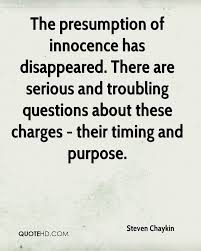
The presumption of innocence is not just a legal concept. In commonplace terms, it rests on that generosity of spirits which assumes the best and not the worst of a stranger.
Kingman Brewester

 Advocate In Action
✓Justice delayed is justice denied.
✓Mulla Committee’s report is not being implemented in true spirit.
✓Finally the root cause is the big gap between law and justice.
LikeLiked by 1 person
Thankyou @ Suchitra and indeed I completely agree with you. But, somewhere I feel that the reason of same is that we have adapted ourselves with the system.
LikeLike
very well written and it encompasses all things wrong about media trials. ‘Innocent untill proven guilty’ should form the basis of any democratic criminal justice system but even in modern democracies, The sancity of doctrine is tramppled by press. Its unfortunate that when a crime is committed , ‘Accused’ is pronounced as guilty by jury of panelist within 45mins of news-show. What is more unfortunate is when advocates who are indulged in matter themselves participate in suchs shows and at times breach their own professional code of conduct. The media trials instead of upholding such basic doctrines, have propogated to society the doctrine of ‘guilty untill proven innocent’. This affects the perception of society towards not only ‘accused’,who deserves every right to free trial, but also privacy of next to kins of ‘accused’ is also severly curtailed under garb of social ‘severity’. Righ to privacy being a fundamental right is murdered for sake of few headlines and bytes. The (in)famous interview of Late Ram Jethmalani with Sagarka Ghose gives an insight about how media has at times lead to spread of fake news.
LikeLiked by 1 person
Wow thanku
LikeLike
Never be afraid to raise your voice for Honesty and Truth..
Best of luck…
LikeLike
Beautifully analyzed the present day scenario with reality
LikeLiked by 1 person
Congratulations Palak for such type of initiative.
LikeLiked by 1 person
Thank you
LikeLike